Radon is the second-leading cause of lung cancer in the United States and the leading cause among non-smokers, according to the EPA. It’s also one of the most consistently elevated environmental hazards in Western Massachusetts homes. After 22 years of testing in the Pioneer Valley, the pattern is clear: a meaningful share of homes here test above the EPA action level, and the geological reasons aren’t going away.
Why the Pioneer Valley Tests High
Radon is a radioactive decay product of uranium, which occurs naturally in granite, pegmatite, and certain other rock formations. The Pioneer Valley sits on a geology unusually rich in these formations — the Pelham Hills, Mount Toby, Sugarloaf, the Holyoke Range, and the granite ledges across Franklin and northern Hampshire Counties.
The Massachusetts Department of Public Health publishes radon-zone data showing elevated readings clustered in:
- Greenfield and the surrounding Franklin County hill towns
- Sunderland, Leverett, and the Mount Toby area
- The Pelham Hills and parts of east Amherst
- Holyoke and the Holyoke Range / Mount Tom corridor
- Pockets in Westhampton, Williamsburg, and Cummington
Within any of these zones, individual properties vary widely — neighboring homes can test very differently based on foundation type, basement floor sealing, and air-exchange patterns. The only way to know your specific home is to test it.
What the Numbers Mean
Radon is measured in picocuries per liter (pCi/L). The EPA action level is 4.0 pCi/L — the threshold at which mitigation is recommended.
| Reading | What it means |
|---|---|
| Below 2.0 pCi/L | Lower-risk. Re-test every 2–5 years to confirm stability. |
| 2.0–3.9 pCi/L | Below action level but elevated. Consider mitigation if levels are toward the upper end of this range, or if living spaces are basement-level. |
| 4.0–9.9 pCi/L | EPA action level reached. Mitigation recommended. |
| 10.0+ pCi/L | Significantly elevated. Mitigation strongly recommended; not unusual in Greenfield, Sunderland, and Holyoke basements. |
For context: average outdoor radon is about 0.4 pCi/L. The average home in the United States measures around 1.3 pCi/L. The EPA estimates a lifetime risk of lung cancer at 4.0 pCi/L (assuming long-term exposure) is roughly equivalent to the lung cancer risk of a non-smoker who is exposed to second-hand smoke.
How Testing Works
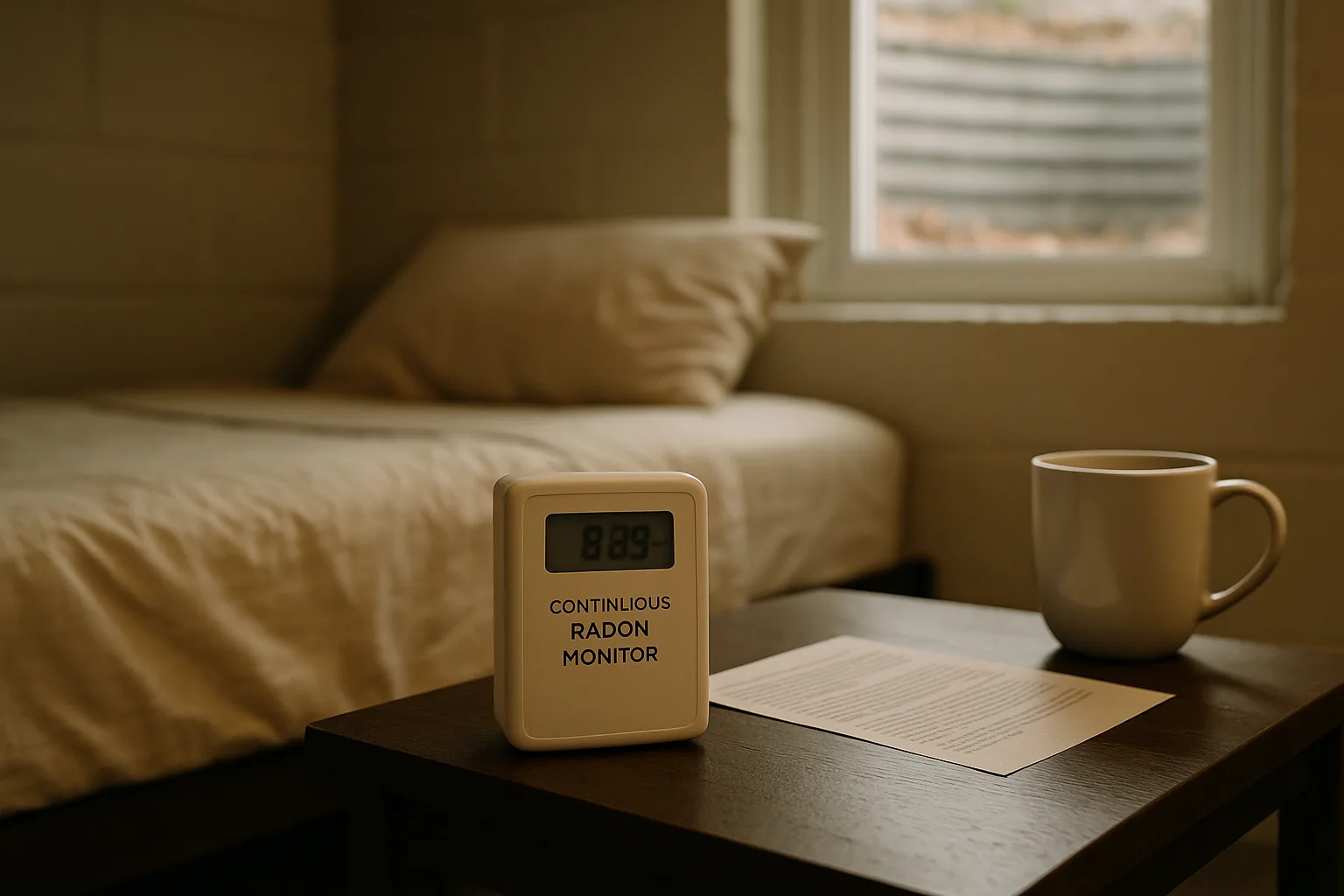
For real-estate transactions in Massachusetts, the standard is a 48-hour continuous-monitor test performed by a licensed inspector:
- Closed-house conditions — for at least 12 hours before and during the test, the home is kept closed (windows shut, normal entry/exit OK).
- Monitor placement — on the lowest livable level (basement if finished/used; first floor otherwise), away from drafts, exterior walls, and vents.
- 48 hours minimum — the monitor records hourly readings, picking up not just the average but the variability.
- Result available at pickup.
Continuous monitors are the standard because the hourly data exposes test tampering (opening windows mid-test will show as a sharp drop on the chart). DIY canisters work for general awareness but most agents and lenders won’t accept them in a transaction.
What Mitigation Actually Costs
If your test comes back at 4.0 pCi/L or higher, mitigation is straightforward — the technology is well-established and reliably brings levels well below 2.0 pCi/L.
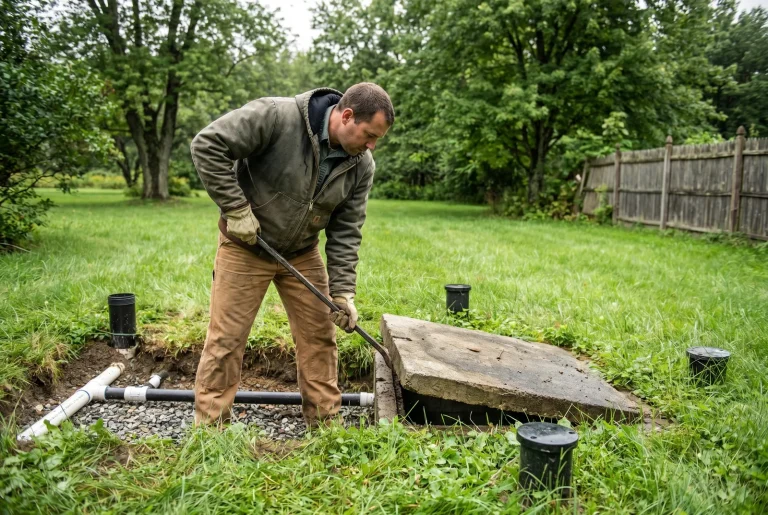
The standard approach is sub-slab depressurization (SSD): a fan installed on the exterior of the home pulls air from beneath the basement slab through a vent pipe that exhausts above the roofline. The negative pressure prevents radon from migrating up through the slab.
Pioneer Valley pricing in 2026:
- Standard SSD installation: $1,200–$2,000
- Complex installations (multiple slabs, retrofitted basements, additions): $2,000–$3,000
- New construction passive system upgrade to active: $400–$800
- Post-mitigation re-testing: included by most installers; standalone $150
Most mitigation systems carry a 5–10 year warranty on the fan and lifetime on the piping. Annual maintenance is minimal — verify the manometer is showing pressure once or twice a year.
Negotiation Strategy When You Find High Radon
If a buyer’s inspection shows elevated radon, common outcomes:
- Seller installs mitigation before closing. Most reasonable; the cost is modest and the system stays with the property. This is the most common outcome in our experience.
- Seller credits the buyer for mitigation. Buyer schedules installation post-closing. Works fine but the buyer carries the project-management burden.
- Buyer accepts the finding and proceeds. Less common, occasionally appropriate when radon is between 2 and 4 and the buyer doesn’t plan to use basement-level living space.
Discuss the strategy with your agent — they handle the negotiation; the inspection report is the factual basis.
New Construction Is Not Exempt
A frequent misconception in the Pioneer Valley is that new construction is somehow radon-safe. In fact, modern airtight construction often produces higher indoor radon concentrations than older drafty homes — fewer air-exchange paths means radon accumulates instead of dissipating.
If you’re buying new construction in the region, test before closing. If the home was built with a passive radon system, that’s a great starting point — but passive systems alone don’t always achieve the necessary reduction; activation by adding a fan is dramatically cheaper at construction than retrofit.
Schedule
Radon testing runs $125 as an add-on to a home inspection or $150 standalone. Schedule online or read more about radon testing in Massachusetts.