After 22 years of inspecting older homes across the Pioneer Valley, certain findings come up so consistently they’re effectively guaranteed on any property built before 1950. None of them is automatically a deal-breaker — but knowing what to expect is the difference between a buyer who walks into negotiation prepared and one caught off guard.
These are the seven we see most often.
1. Knob-and-Tube Wiring
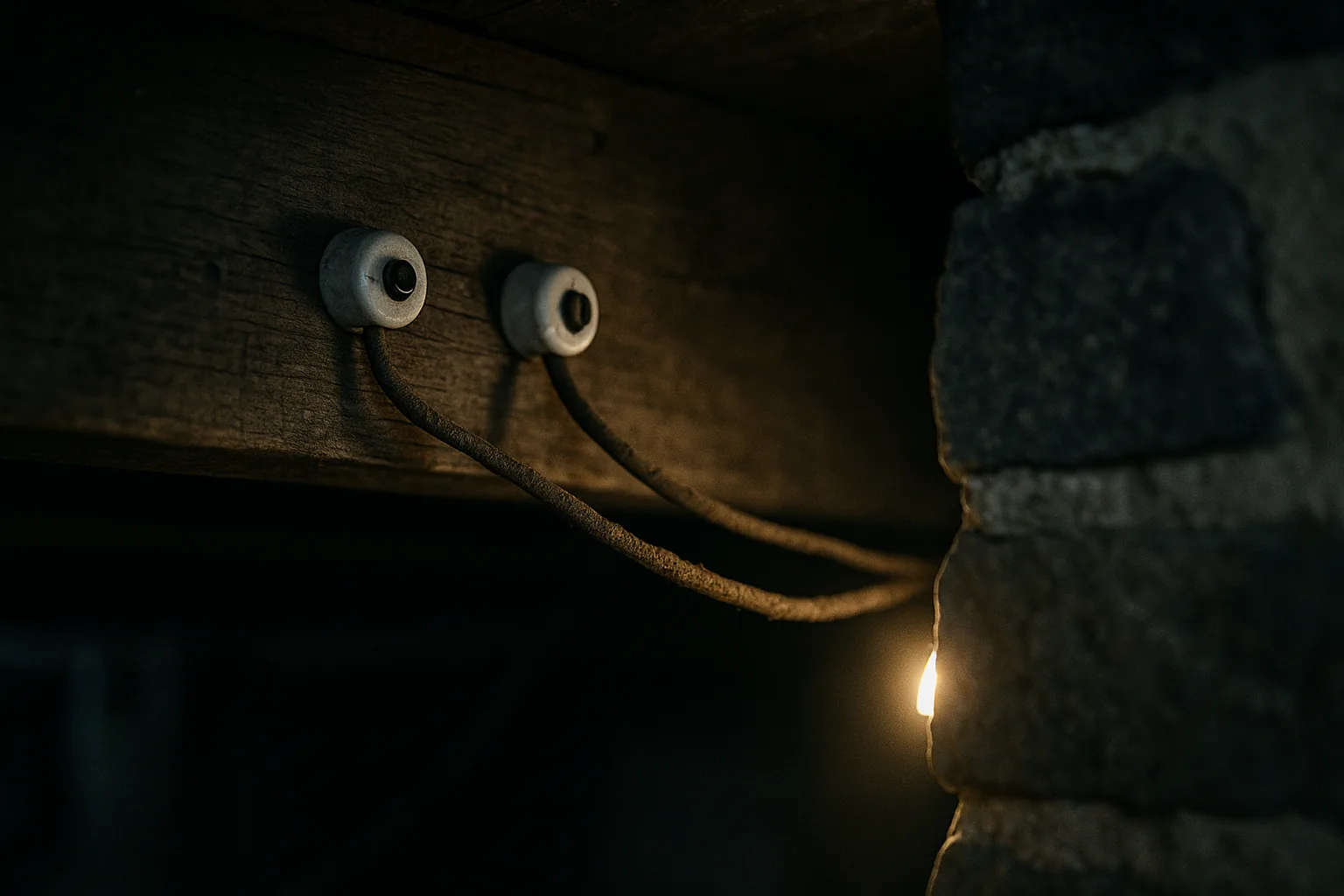
What it is: Pre-1950 electrical wiring installed by passing individual hot and neutral conductors through ceramic knobs (along framing) and ceramic tubes (where wires pass through wood). The hot and neutral travel separately rather than in a sheathed cable.
Why it matters: Knob-and-tube is legal if it’s in good condition and not buried in insulation, but most homeowner insurance carriers in Massachusetts now refuse to issue new policies on homes with active K&T. That makes it a closing-day issue, not just a maintenance item.
What we see: Almost every pre-1940 Northampton, Greenfield, or Holyoke home has at least some original K&T in attic and basement runs. Sometimes it’s been abandoned in place; sometimes it’s still active. Identifying which is which takes a careful walk.
What to expect: Full rewires of older homes run $8,000–$25,000+ depending on size, finish, and whether walls need to be opened. Many properties have already had partial rewires (kitchen, bath, panel run) leaving K&T only in untouched areas.
2. Fieldstone or Rubble Foundations
What it is: Pre-1900 foundation walls built of stacked fieldstone or rubble — often without mortar, or with deteriorated mortar from age. Common in Old Deerfield, Northampton’s older neighborhoods, and rural Franklin County.
Why it matters: Fieldstone foundations are mechanically fine in most cases — they’ve been holding up houses for 150+ years — but they leak. Water management, sill plate condition, and visible bowing or movement are the issues to watch.
What we see: Active seepage in spring, deteriorated mortar, occasional displaced stones, often deteriorated wooden sills resting directly on top of the stone. Sill rot from chronic moisture is one of the most common structural findings on these homes.
What to expect: Repointing runs $50–$150 per linear foot. Sill replacement is expensive ($200–$500+ per linear foot) but rarely needed in full-perimeter scope. Drainage improvements (gutters, grading, perimeter drains) often produce more value than foundation work itself.
3. Asbestos in Pipe Wrap, Floor Tiles, and Siding
What it is: Asbestos was widely used in the U.S. from roughly 1920 to 1980 — heating-pipe insulation, vinyl-asbestos floor tile, asbestos-cement siding (sometimes called “transite”), and acoustic ceiling tile.
Why it matters: Asbestos is hazardous only when disturbed — intact, encapsulated asbestos is generally not a near-term health risk. The issue is what happens during renovation: any disturbance of asbestos-containing material requires licensed abatement in Massachusetts.
What we see: Pipe wrap on old steam and hot-water lines (basement); 9×9 vinyl-asbestos floor tile (kitchens, basements, mudrooms); cement-asbestos siding panels on 1940s–60s houses; popcorn ceilings with asbestos content (less common but present).
What to expect: A visual home inspection identifies suspected asbestos but doesn’t test for it — formal testing requires a state-certified Lead/Asbestos inspector. Costs for testing run $400–$800; abatement when actually needed runs $1,500–$8,000+ depending on scope.
4. Federal Pacific or Zinsco Electrical Panels
What it is: Two manufacturers — Federal Pacific Stab-Lok and Zinsco — whose panels were installed widely from the 1950s through the 1980s and have documented histories of breakers failing to trip on overload conditions. Both are no longer manufactured.
Why it matters: Failure-to-trip means the panel can let a fault progress to a fire condition rather than safely interrupting it. This is a known safety issue documented in industry standards and CPSC commentary.
What we see: These panels show up on virtually every pre-1985 Pioneer Valley home that hasn’t had a panel replacement. Federal Pacific in particular is extremely common.
What to expect: Panel replacement runs $1,800–$3,500 in our region. Usually the seller credits the buyer or replaces it pre-closing; sometimes it becomes a deferred maintenance item the buyer takes on. Note: most modern home insurance carriers will flag or decline these panels.
5. Cast-Iron Drain, Waste & Vent (DWV) Stacks
What it is: Cast-iron drain piping was the standard for residential plumbing through roughly 1960. Common in pre-1960 Pioneer Valley homes; nearly universal in Holyoke and Chicopee triple-deckers.
Why it matters: Cast iron has a service life of 70–100 years before internal corrosion compromises the wall thickness. Pre-1960 homes are now reaching the end of that envelope. Failure is gradual — pinholes leading to slow leaks, then cracks — and catastrophic when it lets go.
What we see: Surface rust and scaling on basement drain stacks, evidence of past repairs (couplings, sleeves), occasional active leaks at horizontal runs. Bathroom remodels often expose cast-iron stacks that were “maybe-fine” but should be replaced while walls are open.
What to expect: Full DWV replacement during a major renovation runs $4,000–$12,000. Targeted replacement of failing sections runs $1,000–$3,000.
6. Inadequate Attic Insulation and Ventilation
What it is: Pre-1950 homes were built without modern insulation standards. Even when later retrofitted, the work is often partial — fiberglass batts laid over (but not replacing) original blown-in cellulose, or insulation added without addressing the ventilation that allows it to perform.
Why it matters: Three downstream effects: (1) high heating costs in winter; (2) ice damming on the eaves leading to roof and gutter damage; (3) condensation and moisture in the attic from poor ventilation.
What we see: Knob-and-tube buried in insulation (a code violation that also creates a fire risk); attic moisture from kitchen/bath fans vented into the attic rather than exterior; missing ridge or soffit vents; ice-dam damage at eaves and roof edges.
What to expect: Adding insulation runs $1,500–$4,500 for a typical home. Ventilation improvements (ridge vent, soffit vent additions) run $500–$2,000. Combined retrofits often pay back in 5–10 years through reduced heating costs.
7. Galvanized Supply Plumbing
What it is: Galvanized steel water-supply pipes — standard residential supply plumbing through the 1960s. Common in pre-1960 Pioneer Valley homes.
Why it matters: Galvanized supply pipes corrode from the inside out, restricting flow and eventually leaking. By 60–70 years old, internal diameter can be reduced by half or more — leading to “low water pressure” complaints that are actually flow-restriction, not pressure problems. Lead solder at joints is also a concern in this era.
What we see: Reduced flow at fixtures (especially upper floors), staining on fixtures from rust/iron release, visible external corrosion at joints, occasional active leaks. Pre-1960 homes in Greenfield, Holyoke, and Chicopee very commonly still have original galvanized.
What to expect: Re-piping runs $4,000–$12,000 depending on home size and finish. Often handled section-by-section as walls are opened for other reasons.
What These Findings Don’t Mean
A 1920s Pioneer Valley home with all seven of the above findings is not unusual — it’s the median property in many of our older neighborhoods. None of these items make the home unsafe, unsellable, or wrong to buy; they’re maintenance and capital items to plan for.
The job of the inspection is to give you the full picture so you can negotiate informed, budget appropriately, and make a buy/walk decision with all the data. After 22 years, the buyers who do best are the ones who know what they’re getting into and plan for it — not the ones surprised at month 18.
Schedule
For a thorough inspection of an older Pioneer Valley home, schedule online or call (413) 522-8004.